Friday, October 28, 2011

Peak Performance, UCONN and the Elite Training Workshop

Between the Starting Strength Seminar and the PICP 2 I found myself with a 10 day gap of ‘free time’.

Since I was already in New York and had the fortune to meet Joe Dowdell, owner of Peak Performance (ranked #3 best gym in the USA by Mens’ Health and conveniently located in Manhattan) a month before at the FMS seminar in Boston, I managed to schedule a little visit for a couple of hours to see how they do things there.

Peak performance is an elite training facility right in the heart of Manhattan, where you can find lawyers and bankers training alongside NFL players and MMA guys.


It’s a large, very well equipped and extremely impressive facility that occupies the entire floor of a building – approximately 10,000 square feet. There didn’t seem to be anything that couldn’t done in the gym and it was easy to see why it was ranked so highly by Mens’ Health.

Whilst I was just sitting back at the protein bar watching the training that was going on, one of the head trainers, Ed Williams, came over and we had a chat about assessments, training and biosignature. 

What was probably meant to be a quick ‘Hello’ escalated into a very in-depth discussion that lasted the best part of 45 minutes and also had input from the other head trainer, Dan Trink and Joe Dowdell himself.

Despite the fact that I was only in the gym very briefly, I managed to get the answers to some questions that have been playing on my mind for a long time as well as pick up a couple of new exercises.

Not bad for a mornings work.

UCONN

In the USA, it seems that there is some type of decent training seminar on every weekend (I think in the UK you’ll be lucky to find 4 good ones a year).

I was fortunate to see an advert for the ‘Elite Training Workshop’ that was being held in Connecticut (a couple of hours from New York) and was on only weekend where I didn’t have any plans, so I signed up right away.

I still had plenty of time to kill, so on recommendation from Eric Cressey to go visit one of the colleges, I contacted the University of Connecticut (UCONN) and was told I could go visit them for a few days.

What I hadn’t realised, was that UCONN is a Division-1 University, which means that (according to Wikipedia) it is a "major collegiate athletic power, with a larger budget, more elaborate facilities and more athletic scholarships than Divisions II and III".

So, if I was going to see a University, this was obviously a great choice.


Associate strength and conditioning coach, Chris West (who turned out to be Cressey's mentor back in the day) took me under his wing and was one of the nicest people I met in the states. He went well out of his way to get me to the University and then gave me a full tour of the facilities, bought me lunch and allowed me to sit in during his sessions.

Chris, or "Coach West" as all the athletes called him, is in charge of strength and conditioning for men’s and women’s football (real football aka soccer) and men’s basketball. The basketball team are current NCAA champions and the men’s football team are ranked #1 in the country. I think it would be fair to say that this makes Chris a big deal.

The facilities for the basketball and American football teams are easily better than some of the premiership football clubs in the UK and the athletes are all treated to the highest professional standards. I can imagine that sometimes, it would be easy for them to forget that at some point they actually have to study

The strength and conditioning facilities were also of an extremely high standard and every single strength training device could be found there. I pointed out that it seemed there was nothing they didn’t have, and Chris said that if there was something they didn’t have – they’d go and buy it immediately.

Whilst the basketball facilities were extremely impressive, the football (American) training facilities were something else. They had the biggest gym I’ve ever seen – 18,000 square feet, comprising of 28 squat racks (the standard measure as to how good a gym is - usually 3 will do), a 70 yard sprint track and an indoor football field (actual size) in the next room that could be used for warm-ups, speed work, sled work etc.

Just the tip of the iceberg

Indoor football field
Indoor sprint track


As the football (actual football) team were in-season, they don’t do a great deal of S&C. However, Chris is responsible for their warm-ups prior to training and playing.

Here he is in action:
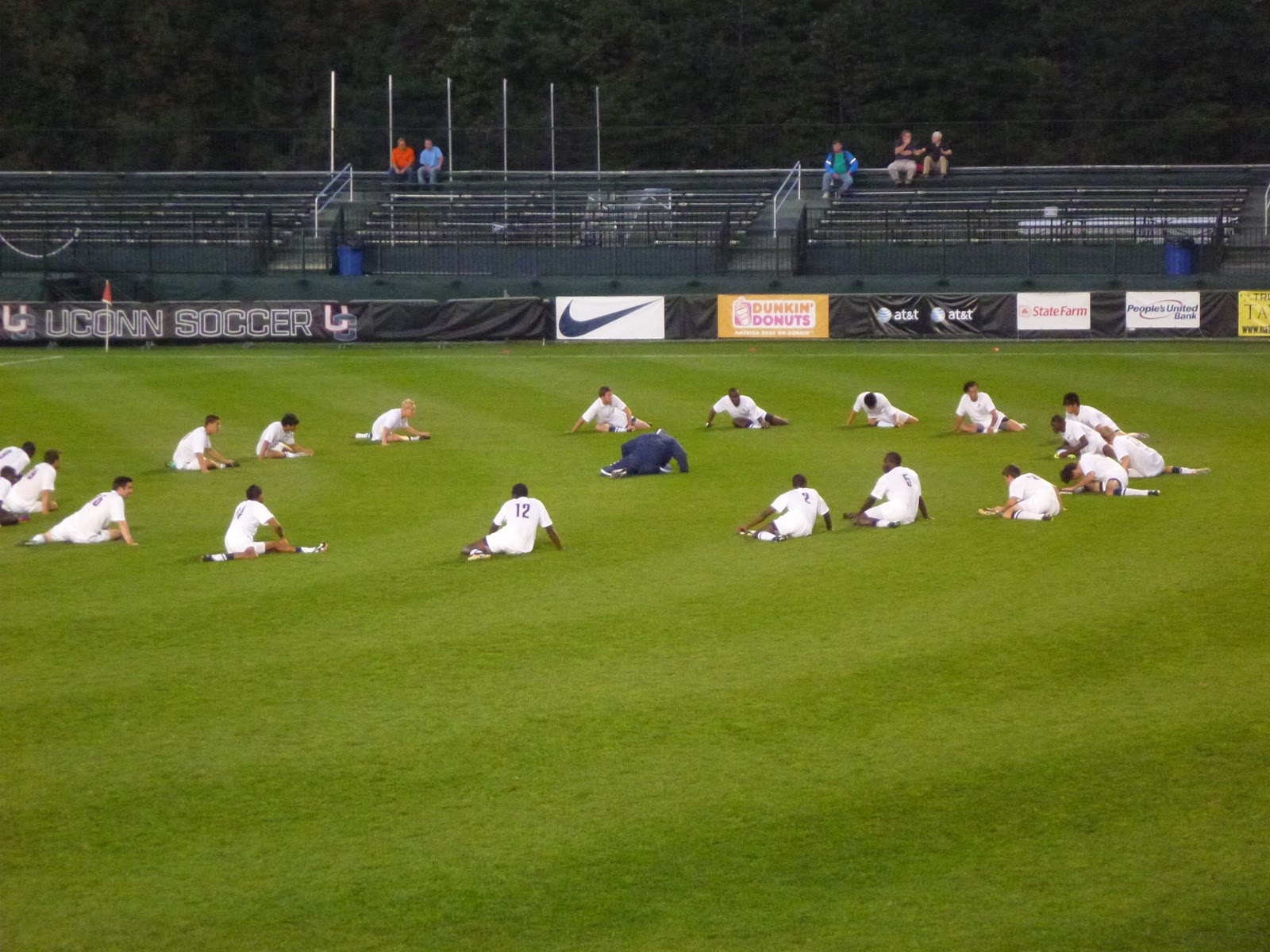
Chris is the guy in the middle, apparently enjoying a bit of "Simon says" with  the footballers. 

That night they played Yale (a much weaker team) and won 1-0. Since it went all the way until the final minute of extra time before a goal was scored, this game did nothing to make me like football any more than I did (which is not a lot). There wasn’t even one single headbutt. Gutted.

The basketball team are currently off-season, so they were training 4 times a week. In addition to their basketball training and studying, these guys were busy full-time.  

Chris’s sessions involved a key lift for either the upper or lower body that had to be improved each workout. Prior to this, the athletes performed a warm-up, core training and explosive work. Following the main lift, the athletes had some higher volume accessory work.

Each session is then subject to a thorough analysis between himself and the interns (and me, because I was there) and they discuss the merits of certain exercises, what they think worked well, what didn’t work well, how they can make improvements, which of the athletes looked good, which athletes struggled etc.

I’ve never seen this done before, but I think it’s a great way to develop yourself as a coach. It showed that Chris was constantly trying to better himself and he regularly would talk about how he’d changed his mind about various protocols over the years.

Elite Training Workshop

This workshop was actually a 2 day event, but since the first day was all about business and how to make your business successful, I’ll leave that all out and focus on the second day, which was all about training.

Day 2 started at 9am. At 8.05am I was just casually checking e-mails and deciding what to have for breakfast in the front porch of my hostel, when I see an e-mail from the night before saying that the lectures today would being at 8am. Nips.

I then put a piece of advice into action that I learnt many years ago:

“If you’re going to be late, be late. Don’t rush around and panic yourself so you can turn up 5 minutes late. Relax and take the time to enjoy your breakfast.”

This is exactly what I did J.

(As it turns out, hardly anyone got the e-mail and people were turning up late all over the place).

The first presenter was the ‘band man' on 'Resistance bands: More than just a training tool'.

I’ll be honest, I didn’t totally buy into what he was talking about, which was essentially using bands as a sole training device – for every client (fat loss to elite athletes). He stated that when pressed for space and time, you could use bands to train large groups of people and then explained how they were great from a business point of view. I do totally agree, but from a results point of view, I think you may struggle after a few sessions.

The practical he did was actually not too bad and quite enjoyable, although I would have preferred to have been lifting some iron rather than struggling against a thick rubber band. 

From a business point of view, his lecture was good as you could easily make good money from running classes that only use the bands. These classes would probably be enjoyable as well for the client, however, I believe that they would become very old, very quick and people would get bored.

Other than being pressed for equipment and stretching, I can’t really see many applications as a sole training device for bands. 

The second presenter was Mike Robertson, on 'Complete Core Training'.

About 2 minutes in, Mike’s computer crashed and he was forced to borrow someone’s hand-out in order to finish. I didn’t notice him flinch, but he claims that it was an extremely stressful 2 minutes until he was able to calm down.

What I enjoyed about Mike’s lecture was that he illustrated a continuum of core training, and it’s important to locate your clients (and yourself) on exactly the right point at the beginning of your training programme.

Do squats and deadlifts increase core strength? Yes.

Does Doris the 86 year old daisy gatherer with a history of back pain need to focus on getting her squat and deadlift numbers up? Errrrm….No, because that might break her in two. 

Does Jim the gymnast with many national titles need to concentrate on improving the side plank? No – because gymnasts are typically beasts who can already handle the fundamentals with great ease. 

Assuming you have to put someone at the bottom end of the continuum (like our beloved Doris), then Mike presented a series of levels you need to complete in order to take them to the point where you can largely concentrate on improving core strength with squats, deadlifts etc. But, be warned – it does take a while, especially if they have a current episode of low back pain.

Mike's practical taught us a series of exercises that he uses with his clients in order to strengthen the core. 
Mike Robertson teaching the waiter's carry

Next up was BJ Gaddour presenting ‘Crash Course in Metabolic Training’.

His presentation was good and contained a lot of information about metabolism and how to use training, nutrition and supplements to keep it elevated and make your body into a 'fat burning machine'.

His practical consisted of 4 circuits, using different styles of training - very handy for training large groups.

Unfortunately, BJ totally blew it for me (no pun intended) during the last circuit, which consisted of 1 minute of slow tempo press-ups, then a rest, then 1 minute of slow temp squats, then a rest and then 1 set of slow tempo overhead presses – all to a track repeatedly going ‘1, 2 up, 1, 2, down’. For some, this type of monotonus training may actually be highly enjoyable, but for me it was a right pain in the arse and I stopped when I realised I couldn’t tell my ups from my downs, so I relaxed and watched everyone else struggle.

BJ then went on to say how this type of training targets the mitochondria. I believe this is because this type of training is more aerobic in nature and aerobic training has been shown to increase mitochondrial volume.

I'm not 100% convinced that this is the most appropriate training modality for getting people into shape quickly and I would also worry that it's not that enjoyable for the client.

This is not to take anything away from BJ, as his energy and passion for training people was evident, and his lecture was well delivered. There is also the fact that he has achieved considerably much more success than I have.

I just didn't buy into all of his methods (some of his other methods described in his presentation did make a lot more sense).

But who knows? Maybe next year I'll have changed my mind. 


Finally, Eric Cressey delivered a presentation on 'Medicine Ball Training for Performance and Health'. This was the best presentation of the day. As I’d been to Cressey’s facility a month before and witnessed a whole ton of medicine ball drills, it was great to actually learn names for them and find out when they are best applicable.

Cressey has a unique ability to say around 500 words every 10 seconds, detailing the most comprehensive facts in functional anatomy, whilst making it easy enough for a toddler to understand.

The practical wasn’t medicine ball related (we might have killed each other apparently), so instead Eric showed us how he evaluates shoulder function – something else I saw a lot of at CP, but didn’t know what it all meant.

He demonstrated how utilising correct breathing techniques can instantly give the individual extra ROM  and how the combined total ROM of internal rotation and external rotation should equal at both shoulders, despite asymmetrical differences in internal and external rotation (something which he had alluded to here).

Furthermore, he pulled one guy out of the crowd and presented a test for measuring thoracic spine rotation. Apparently, this is a genuine test, however, when you see the following photo of the set-up, you may think a little differently.....

There are way too many inappropriate comments to be made about this photo....

Joking aside, this was a great test. From this position, the client has rotate to the left and right sides - all from the thoracic spine. All cheating from the lumbar spine is eliminated in the set-up, so if you don’t have mobility in your thoracic spine then you absolutely will not be moving well in this test. 

So that concluded my fun and games in Connecticut.

Final stop – Rhode Island.

Five things I learnt 

1)  Constantly analyse and evaluate your training sessions. What worked? What didn’t? What needs to be changed ASAP? What does the client need more of? How can a particular exercise be progressed/regressed? 

2) Bands can be used as a very effective stretching tool for the hamstrings and hip external rotators. 

3) Never ever settle for quarter squats. They are a disgusting exercise. In fact, they’re not even an exercise. Either, A) you’re not coaching properly, B) the weight is too heavy or C) the squat is too advanced – regress as needed. Unfortunately, in one instance (I won’t say where), all 3 applied and I made a promise to myself to never allow anyone under my guidance to even consider a quarter squat. 

4) People with a huge amount of ROM at the shoulders need a ton of strength and stability training. A lack of strength in the scapula stabilisers will actually inhibit ROM at the glenohumeral joint and give the appearance of tightness. 

5) For executive clients, you can pretty much guarantee their digestion is shot to bits. HCL works wonders in these cases. 

Wednesday, September 28, 2011

Starting Strength Seminar Day 3


Power Clean

Day 3 began immediately with the power clean. Rippetoe likes the addition of the power clean to a strength training programme because it teaches you to be able to make use of your strength and it enables athletes to become more powerful, jump higher, run faster etc.

Like the best coaches, we were taught from the top down. Starting from the hang, then below the knee, then the mid shin and finally off the floor.

To the best of my knowledge, not a lot of the seminar attendee had Olympic lifting experience, however, during the work sets, I was impressed that the majority of people were able to perform something that resembled a power clean and not a ‘jumping reverse curl’. This clearly demonstrates the effectiveness of the coaching provided to us.

All you have to do is deadlift the bar up to your mid-thigh, then jump, pull the bar up in the air and catch it on your shoulders. Obviously there are a few more technical details (back stays same angle during 1st pull, double-knee bend etc.) but if you can do that, and do it well, you're well on your way to a nice power clean. 

Since I’ve been familiar with the Olympic lifts for roughly 3 years, I took to the power clean very nicely and no fault could be found with my technique. Rippetoe even gave me a complement during the practices saying that it was ‘perfect and exactly how a power clean should look like’. Even whilst wearing trainers.

Flawless, baby


Bench Press

Finally, the bench press – technically, the easiest of all lifts.

This was also the only lift that we were not only assessed on form, but also on spotting technique. We had to safely give a good hand-off to the lifter and then assist in racking the bar on their termination of the final rep. At no point whatsoever we were allowed to touch the bar until it had come to a full lockout after the final rep – and then we had to be quick to grab it and re-rack it.

The only time we were permitted to touching the bar before the end of the last rep was if the bar moves ‘any direction other than up’. If the bar is touched beforehand, the rep doesn’t count and the lifter is allowed to cuff the spotter in the ear as hard as he (or she - could be a woman) likes.

Also the spotter needs to be completely out of eyesight whilst the lifter is doing the exercise. 

In order to assist with the vertical path of the bar, the forearms must be kept vertical, and therefore a fairly wide grip is permitted – much wider than I’m used to. This wider grip actually makes you stronger, but as I’m so unfamiliar with it, I felt quite unstable on the bench – but it’s nice to know I will easily be able to ramp the weight up when I get back to training it again.


I had the pleasant fortune of spotting 'Dwayne' - a large guy who has competed as a powerlifter and has some decent numbers . We were also using the most unstable rack in the gym, which could have easily fallen over at any point. So during Dwayne's easy 140kg for 5 reps, I had to be the guy to save him if all went badly (luckily he was awesome and there was no panic). 


Programming

This is very simple. Firstly, the coach needs to be aware of how far along the progression curve the lifter is. If they're a novice (most people are), then they need to do the 5 lifts regularly and add weight each time. If they're an intermediate (which you'll know because they won't be able to increase the weight each workout), they'll need a volume day (5x5), a recovery day (2x5) and an intensity day (5 x 1). Or something along those lines.

Regarding exercises, coach Rip only likes about 15 exercise. In addition to the key 5, he listed chin-ups, power snatch, front squats, Romanian deadlifts and then went on to say that it got tricky to add anything else. He was completely against single-leg training and stated that if you train properly, you'll be in good balance anyway. Don't think I completely agree with him, but he made an interesting point.

Q & A

For the final part of the seminar, we were asked to think of a question to ask him, which he would then answer in front of the group. I asked him if deadlifting barefoot was a bad idea (since it had been banned the day before) and he went off on one saying that training barefoot is completely moronic and that it will destroy the arches in your foot. He then told me to go and buy a pair of weightlifting shoes and said that his best ever deadlift was in weightlifting shoes as the raised heel allowed him to recruit a bit more of the quadriceps.  Fair enough - I'll add them to my list.

Quotes

I think Mark Rippetoe is one of the most quoted strength coaches as some of the stuff he comes up with is pure genius. Things like, "you can only wear gloves when you train if they match your purse" and  "women who claim to be afraid to train hard because they always "bulk up too much" are often already pretty bulky or "skinny fat" (thin but weak and deconditioned" and have found another excuse to continue life sitting on their butts."

I therefore decided to take note of anything mildly humourous to repeat it here:
  
Attendee: “So what do you think of Triathlons?”
Rip: “I don’t deal with that. That’s.... a mental illness”

“We don’t use PVC pipes in exercises because we’re weightlifters, not plumbers”

“I can squat 600lbs but can’t even do 1 single leg squat. What does that tell you? It’s a circus trick.”

“OK, let’s take a 5 minute piss break”

Rip: “I take the bar out of the rack and do a warm-up set…”
Atendee: “Do you do just 1 warm-up set with only the bar”
Rip: “Haha. Nah!....Six”

(On discussing the possibility of doing ‘Breathing Squats' more than once a week)

Rip: “Yea you could train like that if you wanted, but you’d need to be taking something really special to get you through the workouts”
Attendee: “What you mean like a double dose of caffeine?”
Rip: “No, I mean like cocaine”

Attendee: “So the goal is to squat 3 inches below parallel”
Rip: “No the goal is to squat 405”

(A slim guy is asking about conditioning)
Attendee: “So all you need to do for conditioning is just the prowler?”
Rip: “No. YOU don’t need to do ANY conditioning. YOU need to find one of those all-you-can-eat places...... and then stay there for a while.”

“Doing an ironman is one step away from being dropped off a building – the stress on the body is that intense.”

Rip was the first person to ever renounce their CSCS credentials and wrote to the NSCA saying that they were no longer allowed to say that he had anything to do with them. He said it was an embarrassment to be associated with them because of the absolute rubbish research they were coming up with. He then pulled out a paper in which the researchers had found that a 1RM bench press does not differ whether you perform it on a stable or an unstable surface...

Attendee: "Who would even think to do a study like that anyway?" 
Rip: “That is a key question and I’ll tell you the kind of guy that comes up with a stupid-ass study such as this one. 

*Begins shaking paper furiously* 

"A guy that isn’t very strong.... and doesn’t know ANYTHING about getting strong…..and this is in the journal of STRENGTH and conditioning research!!”

“What causes a stroke? All kinds of shit but not weightlifting.”

 Rip: “I don’t have any credentials after my name. Sometimes, I put M.T. if absolutely need to, like if I'm arguing with a doctor or something”

10 mins later

Atendee: “So..uh... what does M.T stand for?
Rip: “Master Turdsman. Well come on, you gotta have something!”

6 things I learnt:

1) If you take a guy's squat from 200lbs - 500lbs - do you think their core will have gotten stronger? Yes - therefore, provided that the beginner is healthy, in a lot of cases, you can get away without direct core training and just concentrate on the big lifts (although a lot of people will disagree with that).

2) If you are suffering from tennis elbow - do as many chin-ups as possible, rest and then do some more. It may be more painful for a while, but that should flush out the inflammation and you'll be pain free in no time.

3) Don't even mention the double-knee bend to athletes when teaching the Olympic-lifts. If you do the first pull slow enough, the athlete will find that the best position for the beginning of triple extension (the second pull) is if they re-bend their knees. Let them find it out for themselves.

4) In the bottom position of the front squat, there is a much more closed angle at the knees than in the low bar squat. With the knees flexed that much, the hamstrings are contracted and therefore cannot contribute to hip extension during the concentric phase. With the low bar, the knee is not closed as much and the hamstrings are stretched, therefore allowing them to contract in the concentric phase. This stretch will also help to balance forces at the knee joint and keep it healthy. Quarter squats are retarded and for idiots. 

5) The hamstrings anchor the lower back. If the hips shoot up first in the squat, deadlift or clean, the hamstrings are too weak to hold the hips down. Try cueing the lifter to squeeze the hamstrings - that may do the trick first.

6) Active hip 2.0 - the hips MUST be abducted and externally rotated in the squat. By doing so, you free up the hip joint and prevent an impingement from occurring. This allows you to squat deeper. Although the concept of Active hip is more complicated than this - that is the basic premise of it. Don't do anything to correct squat depth until the lifter has pushed their knees out in line with their toes and make sure their hips are externally rotated - that alone will help to gain squat depth in nearly all cases. 

Following the seminar, we received an exam that covered all topics from the past few days. There were 10 questions (one of them was on coaching points - that I happened to miss on day 1. Whoops) that had to be answered in pretty extensive detail. I actually think it was tougher than some of the stuff I had to do in my Masters, which means that becoming a 'Starting Strength Coach' is a credential to be proud of (I'm waiting for my results).

One interesting thing was that the majority of people who turned up for the seminar, were there to improve their lifting technique and hardly any were coaches or trainers. Being a coach or a trainer gives you a huge advantage for understanding  a lot of the technical words and biomechanics and a lot can be learnt that you can immediately use. 

From what I heard, this seminar doesn't leave the USA, so if you ever find yourself with an opportunity to do this seminar - go for it. 


Starting Strength Seminar Days 1 & 2

I added this seminar to my list about a week before flying out as I only found it last minute. Whilst not cheapest of seminars, the coaching points alone have made it a worthy experience and I highly recommend it to anyone who's contemplating it.


The seminar spans 3 days. Day 1 was a Friday night and was 5-9pm (so as not to disturb anyone’s work schedule) in South Brooklyn, NY. Keeping up with my regular 'late arrival style', I arrived an hour late - I had immense difficulty finding the gym, but apparently didn’t miss too much. Day 1 consisted of lecture only, concerning coaching points, why and how we need to get stronger, basic biomechanics and how the biomechanics can then be put into performing a technically perfect squat. 

Day 2 began with the coaching and learning of the squat, followed by the deadlift and then the press.

Day 3 followed with the power clean, bench press, programming and Q&A with Coach Rip. 

Day 1 – Introduction

3 crucially important points for training to get get stronger:

1) Recruit as much muscle mass as possible
2) Use the largest range of movement with the greatest efficiency
3) Use the heaviest weights possible. 

We learnt all the basic biomechanics to gain a full understanding of the above points, including the use of words such as 'force', 'acceleration', 'moment arm', 'sarcomere' and a load of other words I don't think I've used since I was revising in Uni.

However, what made this better than my previous biomechanics lectures was A) this was directly applied to the squat and how the squat could be set up and performed in a way that was the most efficient for the lifter, which is always nice to know, and B) the guy giving the lecture was actually funny and fun to listen to

I won’t go into the complete details (considering Rippetoe wrote a book on the subject, I wouldn't even nearly be able to do it justice), but I’ll mention one thing that is relevant to all the lifts: The bar should move in a vertical path (or as close to vertical as possible) in all lifts. If the bar deters from a vertical path, it creates a new lever arm that causes the lifter to waste energy and no longer be lifting in the most efficient manner. 

We learnt the difference between the high-bar and low-bar positions and the biomechanical differences between the front squat and the back squat. 

Finally, we learnt the importance of being strong. In sports, it is the basis of all attributes to performance. In life, it makes you a better person. 

Day 2

Squat

We began with a quick recap of the previous day followed by the exact technique that was expected of us. The squat is arguably the most important of all lifts, so it was taught first and had the most amount of time dedicated to it.

Rippetoe spent a considerable amount of time discussing the Valsalva manoeuvre and then pulled 3 research papers out of his folder (that he claims to carry with him everywhere he goes, because....well, why wouldn't you?) that completely smash the notion that the Valsalva manoeuvre is harmful. 

In fact, according to the research (Haykowsky et al., 2003), it actually has protective properties that prevent cerebralvascular damage from being done. Rippetoe’s argument against the Valsalva manoeuvre causing strokes or aneurysms was that, if it did, then the carparks of powerlifting meets would be littered with the corpses of powerlifters, which they’re not. 

He made a good point.

With all the lifts, a subject was pulled up in front of everyone and Rippetoe coached them through it, using his set of coaching points, which was available to all of us on a large whiteboard on the wall. 

Following this, we were then put into groups of 5 and assigned a mentor, with each of us taking it in turns to coach one another. When it came to my turn to squat, I was in big trouble. Firstly, I was the only person in the room wearing trainers, which compromised my ability to squat with good mechanics. Secondly, we were using the low bar position, which I have never used before and I found it almost impossible (at first) to refrain from trying to maintain a vertical spine. Thirdly, as I had never used this position and apparently lack sufficient external rotation, my shoulders were nastily contorted in a way they never had been in before. As the weights increased, so did the discomfort

By the time I got to the working sets, the pain my shoulders were in was unbearable and it felt like they were going to dislocate. Because of this pain, I A) couldn’t concentrate on any of the other coaching points and B) couldn’t go as heavy as I’d have liked. In fact, the weight on the bar was downright embarrassing and I'm fortunate I didn't get any photos.

Following all of our warm-up sets, we had to perform a working set with a heavy(ish) weight in front of everyone in order for Rippetoe to critique our form. All I wanted to do was get the set done quickly for the benefit of my shoulders, so I don’t remember exactly what his comments were other than my shoes were inappropriate. According to my mentor, I had managed to self-correct my technique as well, which was a touch, because he thought I was heading for a big public disaster.

A couple of guys failed to squat deep for all of their reps. As they had done for the first couple, it showed they were more than capable of doing so. Rip then asked everyone what that meant. When no one responded he made a pretty crude gesture with his hands to symbolise that the man was in fact, a girl.

Key lesson - squat deep. Always.

During the second warm-up set - I ripped my pants. This scared everyone and they immediately stopped talking and telling me how terrible my form was as they thought I’d torn my hamstrings in half.  


At least I was able to finish my set in peace.


Deadlift

This is where I began to shine. There were 5 steps to the deadlift. Approach the bar, hold the bar, bend your knees, raise chest but keep hips still and then lift. Simples.

Without meaning to blow my own trumpet, I found coaching the deadlift pretty easy (probably because my guy had good form) and was able execute it myself with great form.

My biggest issue for the deadlift was my trainers – the spongy heel prevented me from really driving my heels into the ground and as a result, my weight shifted forwards. However, my pulling technique was described as ‘perfect’ and considering some of the trainwrecks that were supposed to resemble deadlifts were by guys in weightlifting shoes, I didn't really care. 

One of the word's authorities saying what a superb job I'm doing (except for the choice of footwear)


An important point for the deadlift is to do ALL the warm-up sets with a pronated grip as this build grip strength, which is important for athletes. Since only 1 working set is generally required, that can be used with a mixed grip, or if tolerable, a hook grip, which is actually more preferable as it prevents the bar from rotating in the transverse plane, which can (and did for one unfortunate guy) happen with the mixed grip.

Press

Surprisingly, this was the most technical of all lifts, and the only one I really struggled with.
Since bar must move in a vertical path from the shoulders to above the head, it is necessary for the lifter to move their head out of the way until the bar has passed their forehead, then bring the head forward and underneath the bar.

This is where it got tricky. To begin the lift, you need to press the bar up as if you’re trying to hit yourself in the nose, then you need to lean back at the hips and quickly snap the whole body forward again once the bar is clear of the head. On the lowering phase, you need to lower quickly, and once again, aim to hit yourself in the nose. Right before the bar collides with your face, you need to lean back again. But, once the bar has been lowered, you need to immediately press it again and do the required movements of the body around the bar.


My issue was that I kept lowering the bar too slowly and then not staying in a leaning back position at the end of the movement, therefore I was wasting a lot of energy. I need to get back into the gym again sharpish and tidy this lift up....

On the plus side, my mentor 'Julie' found out I was soon heading to Connecticut and recommended a pizza place that got the thumbs up of all the other mentors. 


To be continued.....

Friday, September 16, 2011

Review of Biosignature CE: Lab Analysis


Biosignature modulation is a non-invasive way of measuring why we store body fat in certain areas.  The creator, strength coach Charles Poliquin, noted that where the body stores fat is indicative of various hormonal mishaps, for example, high triceps fat = low testosterone, high hamstring/quad fat = high estrogen and high upper-back/love handles = poor insulin management.


Following the Biosignature seminar, practitioners are able to attend the Biosignature Continuing Education series, which focus on one particular topic that has only briefly been covered in the level 1 seminar, in this case 'Lab Analysis'.

This seminar was conducted by Dr. Mark Schauss, an expert on the effects of environmental toxicity on human health and the use of laboratory testing (www.toxicworldbook.com). His seminar was held at the Poliquin Strength Institute and was a real eye-opener into the world of functional medicine and optimising health.

In his book, he describes the tale of how he was able to save his daughter’s life from reoccurring epileptic seizures of the most severe kind, by running extensive lab tests and correcting deficiencies, enhancing detoxification and eliminating food sensitivities. A true hero. 

The use of lab testing for the personal trainer/strength and conditioning coach can be to optimise their clients’ health and/or performance. The data from lab tests can also be indicative of any fat loss/muscle building obstacles that can then be overcome with correct supplementation protocols/lifestyle changes.

Right at the beginning of day 1, Charles Poliquin introduced us to Pat Mendes – a superheavyweight Olympic weightlifter – the USA’s best chance of a gold medal next year and who is also similar in size to a small house (completely irrelevant to the rest of this blog but still thought I’d mention it).


Following this introduction, we began with lectures on the different blood tests available; Comprehensive Blood Chemistry, Urine Organic Acids and Plasma Amino Acids. Within each test, we learnt what may be occurring in the body with high and low readings, optimal scores that you should be achieving and strategies for correcting abnormal scores.

On day 2, Mark presented us with case studies of his patients with their conditions described so that we were able to learn how different complaints are manifested in test results. Furthermore, we were introduced to data from Mediator Release Testing (MRT – the gold standard measure of testing food sensitivities) and finally, we were presented with test results, from which we had to work out the condition.

 Day 3 was only a half day, we had one lecture on hormone testing, which was then followed by a test on everything we’d learnt so far, which had questions like:

An individual has an Alkaline Phosphatase of 27. What should you do? 
a. Check his or her zinc level  
b. Send them to their primary care practitioner immediately 
c. Recommend that they stop drinking any form of alcohol
d.Retest to make sure the result is correct

Simple eh? (That was actually one of the easier questions) Fortunately, Mark was very relaxed about the test and provided it on day 1, which allowed me to try and learn it inside out. Swish.

The answer is ‘a’ by the way – having an alkaline phosphatase level that low is indicative of a zinc deficiency.

This was followed by one final lecture on ‘how to prevent cognitive decline’, during which, Schauss presented a number of different nutrients that have had extensive research backing them to support brain health during aging and prevent nasties such as Alzheimer’s and dementia. Some of these nutrients can also be used pre-workout to provide an extremely energising boost and give you a great ‘Whoa!’ feeling (as one attendee described it) and increase strength levels.


Like all other doctors in the know, Schauss completely smashed the notion that cholesterol causes heart disease and told us that by having a total cholesterol of <160, your risk of having cancer, an accident of any kind or a stroke, significantly increases. He told us stories of doctors trying to lower peoples’ cholesterol to dangerously low levels, despite the fact that their low cholesterol was causing them to feel ill and see their doctor in the first place. Since there’s massive money to be made in the statin (cholesterol lowering drugs) industry, it may be a very long time before the association between cholesterol and heart health is ignored.

For an amusing (and somewhat sad) story about a doctor versus a 'red-meat eating alpha-male strength coach', read my friend Tyler’s blog post here.

Mark was hugely against vegetarianism, stating that they ALWAYS have horrific blood chemistries (always deficient in carnitine, glycine and vitamin B12 – very very bad). This can lead to a host of health problems and make losing body fat/increasing muscle mass a real uphill struggle. Schuass said the only time he ever came across a vegetarian with healthy blood was a bodybuilder who spent 8-10 hours a DAY on food preparation. Assuming that any vegetarian who does not have this time luxury and but is conscious of their health – just eat the damn steak.


As an expert in the area of toxicity, he taught us that this is one of the biggest threats to mankind that it may also be a major contributor to obesity. To illustrate this point, I have drawn a highly sophisticated diagram using Microsoft paint:


If the individual is sedentary, over time this can lead to a large amount of fat accumulation as fewer calories are burnt at rest. Furthermore, toxins are stored in fat cells, so when body fat is lost toxins are released into the body. If the individual’s detoxification pathways are not up to scratch, they may feel ill as a result and quickly give up on the fat loss programme, thinking that fat loss is a bad idea (no, getting fat was a bad idea).

How do you know if you’re toxic? Well, if you’re breathing then you can safely assume you are toxic – toxins are everywhere.

Reducing your toxic burden (for example, reducing your use of plastics) and making some attempt to enhance detoxification (eating more protein and fibre and taking a liver support supplement will help) could have a significant impact on what may otherwise be a real uphill struggle. 

One real health scare is the addition of ‘phthalates’ to many cosmetic products. Phthalates are nasty compounds that have been shown to cause a myriad of health problems. They’re so bad in fact, that they have been banned in the E.U. (phew), but not in the U.S. We were told a story of a couple who both had recurring cancer and had gone to see Mark Schauss. Their blood work showed that their phthalate levels exceeded 15,000% of what they should be (i.e. zero), which was highly likely to be the cause of why their cancer had returned. The couple were both confused as they ate organically, drank filtered water and otherwise lived very healthy lives. It turned out that the woman had an obsession with 'glade plug-ins' -  known for their high levels of phthalates - and had 2 in every room in the house.

By the end of the seminar, I was familiar with many new long science words that would have impressed my old biology teacher. In addition to this, I also believe I have a clearer understanding in how to interpret blood data. How long it will be before I begin to use this with clients? Probably quite a while as it's an extremely complex area that I would need to learn more about, but it would be nice to have some practice with myself first and see if I can fix a few things.

10 things I learnt: 

1) If you (or someone you know) are pregnant, your cholesterol levels are supposed to be high. Should your doctor make any attempt to lower them – he is an idiot and a danger to you and your unborn child’s health - go and find another doctor. 

2) In order to get enough nutrients from food, you would need to eat approximately 5500-6000kcal a day (this was obviously not the case when soil quality was good), therefore nowadays, supplementation is essential for optimal health. 

3) Margarine and motor oil are almost identical on a molecular level. Apparently, it is possible to run a car off margarine. Eat real butter instead. 

4) Washing your hands regularly is the only consistent way to increase albumin levels. Why is this important? Elevated albumin levels are associated with increased longevity. 

5) Reducing sodium levels too much will increase your risk of a heart attack. 

6) If 500 men take cholesterol lowering drugs, only one of them will saved from having a heart attack. The remaining 499 will have muscle pains and overall poor health as statins come with health risks. 

7) By itself, water is no good for staying hydrated -you must have added electrolytes (doesn't include lucazde etc). This is an extremely important fact for when training/competing. 

8) The more stress you are under, the more protein you need to consume. 

9)  If you test sensitive to beef, the chances are that it was ‘grain-fed’ – you will probably be OK to eat ‘grass-fed’ beef as a natural diet changes the protein structure of the meat. 

10)  It appears that if you stay on top of your blood chemistries, you stay on top of your health. It would also appear that you can prevent almost any disease by regularly having blood work, as many diseases, if not all, present themselves long in advance by means of deficiencies in nutrients and excesses of toxins. By being aware of this, you can prevent the deterioration of health that is generally associated with ageing.

Now I’m in New York, 5 hours away from the ‘Starting Strength Seminar’ with Mark Rippetoe. 

Apparently, ‘he swears a lot and will call you a pussy’ (Charles Staley).

Sounds like a great guy! 

Thursday, September 8, 2011

Wholefoods, Mike Boyle's Gaff and Street Acrobatics


Wholefoods Market

There is a sight possibility I may have an obsession with this place:


Yes, I did take a photo of a supermarket.

Since I’ve been in the USA my nutritional habits have been less than stellar. To be honest, they've been downright abysmal. Eating was always going to be a challenge when constantly moving around hotels, motels, hostels and the occasional sofa. 

However, as luck would have it, the hostel I was staying at is less than a 5 minute walk to the nearest Wholefoods Market – the only place I’ve been able to eat reasonably well, and as a result I was making 1-2 vists a day during my time in Boston. 

It’s not exactly the cheapest of supermarkets, but on the flipside – you're paying for quality. Of course, not every product they sell is healthy (like some of the extremely tasty desserts), but you won’t find any nasties as part of long list of ingredients that would look more appropriate on the side of a brightly coloured plastic bottle that says ‘keep away from children’ written on the label.

Furthermore, nearly all the fruits and vegetables are organic and the ‘wild’ and ‘grass-fed’ animal products are clearly labelled and readily available. All the toiletries are natural and appeared to be void of the word ‘paraben’. I didn't check every single one (I wasn't that odd - and I had more important things to do - like finding a 'healthy' cheesecake to go with my dinner), but you could generally tell from the labels of most and I recognised one of the English brands (Bulldog), which is definitely pukka.

I am fairly convinced that if you did all your weekly shopping at a Wholefoods Market, your health markers would make a significant increase and you'd have an improved quality of life as a result.

As an even bigger bonus, it contained only about 10% hippies at any one time so regular people don’t feel too uncomfortable (I believe it's policy). 

Mike Boyle Strength and Conditioning

My purpose of my visit to Boston this time round was to visit Mike Boyles Strength and Conditioning. Through a mutual friend, I had been put into contact with Brendon Rearick – one of the strength coaches at the facility.


Like all other good strength and conditioning facilities, it is located on an industrial site in the middle of nowhere and unreachable by anything other than magic carpet. As it happened, on the same day I went to visit, the east coast decided that it had had enough of summer turned its freeze on, with some added rain. Unfortunately, no one told me and I rocked up in shorts and t-shirt, shivering and soaking.

I would have been less shivering and soaking if I’d properly listened to the directions given to me by kind girl in a dry cleaners and not missed my turning and walked for a good mile in the wrong direction.  I should also add that she even showed me on a map where to go and, for no particular reason, concluded that both she, and the map, were wrong. 

Big whoops.

Anyway, Mike Boyle’s Strength and Conditioning was voted as the #1 gym in the USA by Men’s Health, which as far as gym awards go, is like winning an Oscar or the Nobel Prize or being Knighted by the queen – or all 3 on the same day.


The MBSC is pretty massive – about 12,500 square feet. It contained zero machines, 5 squat racks, 4 lifting platforms (put into the floor), cables, a huge astroturf, a room dedicated to warm-ups, an outdoor astroturf and a gigantic wall for medicine ball throwing. In addition, it also contained every single accessory that you can find in the Perform Better catalogue.

When I arrived, it was pretty quiet – just a few people doing their own thing. Then after lunch, BOOM the place erupted and there was a steady stream of about 40 or so athletes training at once. Apparently, in the peak of summer - it can reach 150 and the place is heaving. 

Each coach was assigned a group of athletes and took them through their sessions: Warm-up, lateral and linear speed, plyos, O-lifts, strength work then core work.

I saw a lot of sledge work as well, but instead of using it to induce spaced-out vision and vomiting, it was being used to promote correct acceleration mechanics - 45 degree angle, application of large ground forces and explosive triple extension. Smart. 

I picked up a few coaching points for some of the lifts and learnt a few new speed drills – all which I expect to come handy in the near future!

Big thanks to Brendon for letting me come watch for the day!

Street Acrobatics

In Boston, there is this thing called the ‘Freedom Trail’. Essentially, it’s a red line that you follow round the city that takes you to various historic hot-spots to give you a real insight in the Bostonian past.


Last week, when the weather was hot, I decided to tackle expedition around the city and learn a thing or 2 about Boston. 

About 15 minutes into it (roughly coinciding with the time I was getting a bit bored) I happened to see a large crowd gathering around some rapidly moving bodies. So I head over, and it’s a group of street performers doing a bunch of things like this:


And this:


Then they build up to the grand finale and I witness one of the most incredible athletic acts I’m ever likely to see by a street performer:


As a big fan of risk and a bigger fan of back flips, I was very lucky to have been able to watch an extremely talented guy put the two together. 

It reminds me that I am actually owed a back flip tutorial. Lucy - if you read this (you had better be) - we'll just start with just 2 people first yea?

This minute…


As of present, I’ve just pulled up in Rhode Island. I arrived in Providence earlier today, which has just won the award of ‘the city I feel least likely to get stabbed in’ and loses the award for 'most descriptive bus stop.'

No times, numbers, shelter or direction and easily missable if you were walking the other way.


I'll be crashing here for the night before heading over to the Poliquin Strength Institute in the morning for a 3 day seminar with Mark Schauss on ‘Lab Analysis’. My preparation for this seminar has been to read his book 'Achieving Victory Over a Toxic World' and that's it. Assuming that everyone else has done a lot more than that, and regularly takes Biosignature readings of their clients AND has them regularly do blood work, providing them with an infinite number of questions already – I am going to be well out of my depth.

My plan is to pull a total blag-job so that by the end of the day people will think I work in a lab. Failing that, I'll just crawl into a small space in the corner if it get's too intense. 

After reading his book (which was quality), I'm expecting to learn a few gems, which may help to accelerate fat loss - particularly for those that are REALLY struggling to get it going - and make massive improvements in health and well-being. 

I will be taking a ton of notes and as long as I understood at least 50% of what was going on, I'll do a nice big write up on Sunday :-)


Wednesday, August 31, 2011

Perform Better Functional Training Summit - Day 3

Day 3

Originally, I meant to fly back to Boston after the seminar had finished, but after I got back to the hostel on day 2 – I saw that my flight had been cancelled.

So, I got up nice and early to try and rectify the situation – to no such luck.

I had another very casual, last minute exit from the hostel to begin the final day of the seminar.

Vern Gambetta – Teaching speed: Theory and application

Vern Gambetta discussed the development of linear speed in athletes of all ages. Most of his work has been with track athletes, although some of it may be relevant to those in team sports – as achieving top speed can be desirable in some cases:


In addition, training top speed can help reduce the incidence hamstring injuries. 

When training for speed development, it’s important to make sure that the mechanics are perfect, as only ‘perfect practice makes perfect’. The coach must be able to justify every drill that is prescribed to the athlete, and in many cases Vern had seen young athletes attempt to copy more advanced sprinters. Unfortunately, the drills that they copied were way too advanced and the young athletes used poor technique, which could ultimately hinder performance.

Lesson 1 – The arms get rid of rotation during sprinting, thus provide energy into the system. This can justify training the upper body to enhance speed development

Lesson 2 – When racing – you need to win the race, not just the start

Lesson 3 – Contrary to popular belief, the arms do not remain at 90° during sprinting. The elbow angle decreases when the arm comes forward and opens up at the back – forcing the athlete to stay at 90° may be detrimental to performance

Charles Staley – Olympic-stlye weightlifting simplified (lecture)

Charles Staley is passionate about Olympic lifting – he wouldn’t be training otherwise.

He discussed the appropriate progressions that can be used to teach the Snatch and the Clean and Jerk and went into detail the mechanics of each lift.

A key reason he thinks that they are great for athletes, is that they’re ‘fun’ to perform. Anything that is fun to do is likely to result in greater adherence – and this is an underrated factor when it comes to training. He noted that when you hit a golf ball with perfect precision, you feel it. The same can be said about the Olympic lifts and so it can be used as a tool to get people to really engage with their training.

An important point that we were taught to understand was that the O-lifts will not necessarily induce performance enhancement in all sports - contrary to the belief of weightlifting coaches who think it will fix any sport.

Lesson 1 – If you’re using the Olympic lifts to enhance power development – you MUST be technically proficient – otherwise they’re a waste of time.

Lesson 2 – Don’t coach the errors that don’t exist – only make improvements on what needs to be improved.

Charles Staley – Olympic-stlye weightlifting simplified (practical)

His practical followed his lecture, teaching us how to appropriately perform the O-lifts.

I really liked his calm method of teaching and actually picked up a few hints that instantly made my technique better. I have had a large number of lessons in Olympic lifting and by far was his the easiest to follow.


We were first taught the clean and jerk, which according to Charles, is easier for most athletes, and comfort with this lift translates into easier learning for the snatch.

He had us first being able to rack the bar. This is the most important part and should always be taught first, as an athlete who can’t rack the bar, won’t be able to clean properly.

We then performed the ‘transition phase’ for 2 reps, before explosively going into triple extension. He had us to this so that we should be create a desire to try and catch the bar – despite not telling us to.

We then followed the same procedures for the snatch

Lesson 1 – A key difference between the clean and the snatch is that in the clean, the bar will bounce off the thighs, whereas in the snatch, the bar should slide up the thighs and into the hip (don’t hit your 
junk!)

Lesson 2 – After performing cleans, up the weight and perform some clean pulls. Following these, up the weight further – you are now perfectly warmed up for deadlifts.

I will definitely try and be back next year – the quality and quantity of the information gained is second to none.

As I found out earlier, thanks to Hurricane Irene, my flight was cancelled and initially I had to wait a week in California until I could fly back. The hostel is in the middle of no-where and since Gustavo left (in his car) I wasn’t even sure if I could buy food from anywhere.


On my first day of doing nothing, I took the time to take these nice photos of the Pacific ocean though:


So time well spent...

Fortunately, before exhausting my photo taking capabilities forever, I was able to get on a flight early Tuesday morning.

So 3 buses, a taxi (because I got lost), 1 flight, a  4 hour wait in Texas, another flight, 2 trains, another bus and a lift in a truck with a Brazilian stranger – I arrived safely back in Boston.

Easy.